Honks and Thumbs Ups At the Glen Canyon Trees Protest

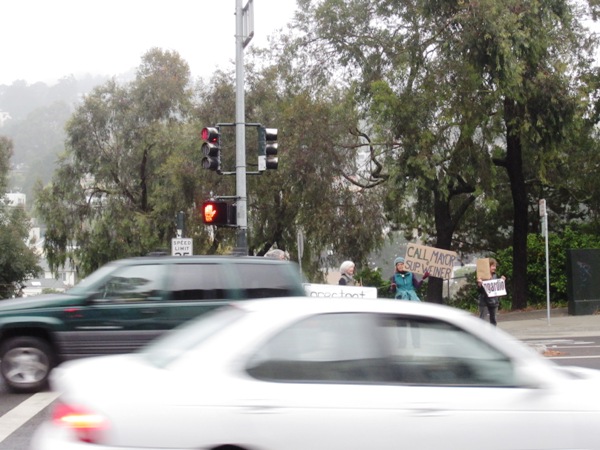
Thank you to everyone who came out to Elk and Bosworth for the protest, despite the rain and the vice-presidential debate. And for those who missed it – it was amazing. Here’s a first-person account:

I’d been told to expect  12-15 people, enough to carry visible signs at the narrow intersection without blocking traffic. That’s what they told the police, who would send a patrol car to drive by and make sure we weren’t getting in trouble.

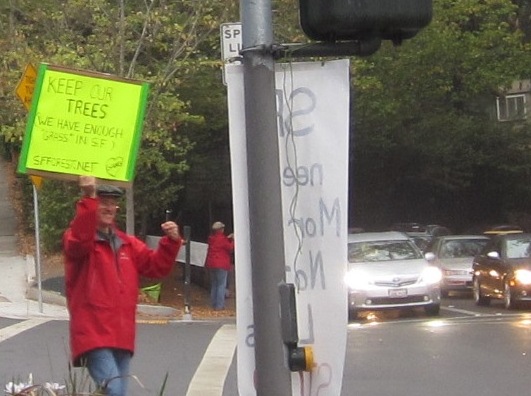
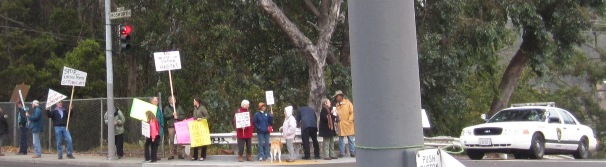
In fact, when I trudged up the steep slope of Elk, a few minutes late, I counted over 30 people there already.  The organizers had promised not to block the sidewalk, so the group spread out and stood on each of the corners of the intersection.

It was a small forest of handmade signs:

RECREATION, NOT DEFORESTATION………. PRESERVE OUR URBAN HABITAT ………. KEEP HEALTHY TREES………. CALL MAYOR AND SUP. WIENER………. OWLS NEED TREES………. TO KILL A TREE IS A CRIME/  PARK & REC WANT TO COMMIT 300 CRIMES ………. STOP DEFORESTATION………. SAVE OUR FORESTS ………. STOP KILLING TREES

The lights cycled through red, amber and green,  and traffic streamed past. A bus moved slowly by, and all the passengers waved and gave us thumbs-ups. Cars honked their support, and we waved back.  Each time the lights changed, in each direction, there was a symphony of honks.

“Each honk is a vote,” joked one of the protesters. The mood was jubilant. We had a lot of support.

Even earlier, as I parked, and wrestled my sign out of my car, someone saw me from her house, smiled and gave me a thumbs-up.

Another neighbor came out and called to us. “Come here,” she said, standing out of the rain. “Explain this to me. What is all this about? Cutting down trees? Sixty? Are they mad?”

A passer-by asked for a flyer.  Fortunately, someone had carried a few to the protest. Several people noted the URLs of the two sites GlenCanyon.net and SFForest.net,  and said they’d go there for more information.

Eventually, it was 6.30 p.m., and dusk was falling together with the rain. One last set of beeps from passing cars, and I helped to take down the signs. It was time to go.

A lot of people had seen the signs. Some already knew about the problem. Maybe others would be inspired to go to the websites. Were we in time to save the trees? We don’t know. But if they aren’t saved, they will be remembered.

Posted in Felling Trees | Tagged , , , | 4 Comments

Street Protest for Glen Canyon Trees: 11 Oct 2012, 5 p.m.

GOOD OLD-FASHIONED SAN FRANCISCO STREET PROTEST

As a follow-up to our very successful meeting on Saturday at the Glen Park rec center we are holding a peaceful street protest at the corner of Elk and Bosworth Streets (corner of Glen Canyon Park near the baseball diamond) to bring attention to SF Rec and Park’s plans to remove 300+ viable trees from the park. We need to act fast – construction (and associated tree removal) will start on October 15th!

When:  Thursday, Oct.11 from 5:00 – 6:30 PM,

Where:  At the corner of Elk and Bosworth.
Come and show your support for Glen Canyon Park!

WHAT TO DO

We gather at the corner of Elk and Bosworth Streets at 5 PM.

We encourage you to bring your own protest sign – we will have some extras if you cannot bring your own. Some tips:

  • Bring a sign that can be easily read by those in rush hour traffic —
  • Be sure to include www.SFForest.Net on your sign so motorists will know where to go for more information.
  • Keep the poster messages clean – we are family friendly

Potential messages for signs could use the following themes

  • Save Glen Canyon trees – call Supervisor Wiener
  • Stop the deforestation – call Mayor Lee
  • Keep Glen Canyon wild – call supervisor Wiener
  • RPD – Preserve our urban habitat
  • RPD – get some common sense
  • Save my taxes and save these trees
  • More recreation, less destruction

Kids and dogs (on leash only) are very welcome.
We want a safe and peaceful protest – we must stay on the narrow sidewalk, not interrupt auto or pedestrian traffic and not use any loudspeakers.

Message limitation requests:

  • The SFFA does not want to stop the long overdue upgrades to park facilities – we want common sense preservation of viable trees. Please do not bring a sign asking for a halt in construction.
  • Please do not bring any signs with messages about the 2012 Parks Bond (Prop B). The SFFA negotiated language in the bond that will (hopefully) prevent 2012 bond funds from being diverted to NAP. As a result, we will not oppose Prop B; this rally is neutral on the bond.

If you cannot attend our rally please contact:

Supervisor Scott Wiener, (415) 554-6966, scott.wiener@sfgov.org
Mayor Ed Lee, (415) 554-6966, mayoredwinlee@sfgov.org
Park Commission, (415) 831-2750, recpark.commission@sfgov.org

UPDATE ON OUR OCTOBER 6TH MEETING

(The initial report is HERE.)

We were clear we do not want to stop the long awaited improvements to park facilities.  However, the plans for the upgrades to the tennis courts, playground, rec center, trails, and natural areas include removal of hundreds of trees that could be spared. At our Saturday meeting we presented slides from Sunshine Act (SF freedom of information act) documents and data showing the vast majority of 300 + (closer to 400) tree removals for the various projects and the “natural areas” are not for safety reasons. There are some hazardous trees that do need to be removed and we do support removal for legitimate safety reasons. We also showed how removal of so many trees will change the character of the park forever.

Our audience agreed trading mature trees for saplings is a bad deal. We showed pictures and featured speakers who revealed Rec and Park’s extremely poor record of tree planting and sapling survival. At the very best, replanting = “restoration” in 75 years.

We heard from our audience that these extreme tree removal goals had not been communicated to them. The “community process” showcased the facility improvements while remaining silent on the extensive, expensive, and unnecessary tree removals. As a result, we have asked Rec & Park for a community walkthrough of the arborist plan.

When we showed we had support of 20 other neighborhood organizations against NAP and unjustified RPD tree removal plans many who participated wanted a more independent analysis and position from the Glen Park Association. The Glen Park Association is currently highly supportive of RPD’s plans to remove trees.

WHO WE ARE AND WHAT WE DO

The San Francisco Forest Alliance is an authentic grassroots organization with a membership that has no professional or financial dependencies or relationships with our City or SF Recreation and Park Department.

The SFFA is also fighting against the plans that the SF RPD Natural Areas Program has proposed for our city parks as a whole:

  • Trees – removal of over 18,500
  • Trails – loss of 9+ miles of recreational trails to fenced-off native areas
  • Toxins – high-maintenance plant species requiring ongoing pesticide applications
  • Taxes – “20-year plan” diverting $ tens of millions from traditional park programs

Many thanks for your support!

Posted in General | Tagged , , , , | 1 Comment

What is a TREE? by Dolan Eargle

We received this from Glen Park resident Dolan Eargle of the Trees Company, and it is published with permission and minimal edits.

What is a TREE?

Concern for the trees of Glen Park is understandable, but I rather think many may have wrong impression as to “what trees” we are talking about. From much of the conversations lately, it appears that there is little understanding of the nature of the many varieties of trees. Just what is a “tree” to someone?

As I understand it, there are FOUR groups of trees involved here.

1.  The most easily understood group of trees are those that crowd the Recreation Hall and would hamper the reconstruction proposed. Most are older trees, some are twisted, but not really hampering, any contractors’ work. Rather, they are enhancing by their uniqueness (hundreds can be seen in Glolden Gate Park). Why remove these???

NOW disconnect this group from:

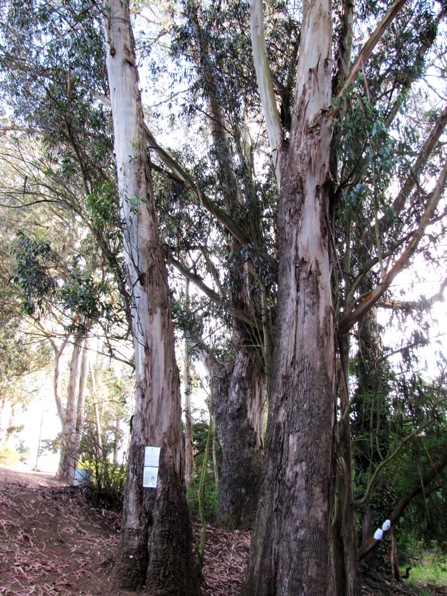
2.  At least 9 giant historic eucalyptus trees about 100 years old, planted by Adolph Sutro’s workers. These are perfectly healthy, in excellent shape — they collect summer fog and dampen the ground beneath, they act as a giant year-round windbreak (no other trees here do that), they hold the soil with their root systems, they furnish shade. NO OTHER NEWLY-PLANTED tree can do these things.

3. Add to these a goodly number of eucs scattered between the Rec Hall and the schoolhouse. These have the same characteristics as in #2. A couple of these are leaning into a path along the west side of creek — dangers? They have been leaning for about 50 yrs. Remove them? I don’t think so. Another couple do look like they could be taken without comment.

But then another giant euc adjacent to the “owl tree” and “dam” on Islais Creek has been tagged.
Why on earth??? It is good, healthy, and useful.

4. There seems to have been some sort of survey through the large old eucalyptus forest alongside O’Shaughnessy Blvd (part of the Sutro planting).

This forest has been here without much concern for decades. Yes, a few of the trees fall every once in a while as trees in a forest are wont to do. Endanger anyone? No. This is a real forest. Why was such a survey made here in the first place? Now someone wants to remove dozens of these trees? Leave them alone.

TREES AND TENNIS COURTS

With special regards to #2.

As seen in the proposed remake of the Park, these valuable, unique trees will be removed simply to reposition two tennis courts!!! I spoke with one of the project designer presenters early on in this discussion. What would it take to do this? First, the trees would be cut and chipped. Then specially-equipped bulldozers with teeth would rip out the roots. Then, upon closure of Alms Road, they would carve into the hill to remove some soil. Next a heavy cement wall would need to be poured — approximately where the trees are now. Next, tons of soil would be brought in to fill the area where the tennis courts would be placed. Then, tada!! the tennis courts could be installed with behind fences. New trees would be planted where the eucs are now. I asked, “What kind, size?” No answer.

Doesn’t this sound a lot like “make work” along with a total disregard for valuable trees?
Alms Rd. is used by almost all persons entering the upper park for a walk. Take it away???

Simple resolution: Move the tennis courts northward about 15 feet to where the ugly walkway is now. Plant a neat line of new trees alongside of it. Leave the giants and Alms Rd alone.

“PLEASE SAVE MONEY”, everyone asks. Oops, not as much money to be made as on useless projects.

Dolan Eargle,  Glen Park resident
Director, Trees Company

Posted in General | Leave a comment

SFForest Public Meeting, 6 Oct 2012: Report

This report is republished from our SFForest.net site with minor edits.

—————————————————————————–

STANDING ROOM ONLY

The San Francisco Forest Alliance (SFForest) is very concerned about the hundreds of trees slated for destruction in Glen Canyon, starting as early as this month. The appeal period for the first phase of tree removal ends October 14th.  So SFForest called a neighborhood meeting at Glen Canyon Recreation Center on October 6th, and our volunteers distributed leaflets all through the area. We’d been concerned that many people who told us they wanted to come had prior plans owing to Fleet Week, Games, the Hardly Strictly Bluegrass Festival, and other activities.

We need not have worried. All the seats were taken by the time the meeting started. By the end, a crowd of people stood at the back and sides of the room. We estimate that some 80-100 people attended. Six people spoke. The Question time, after the presentations, was vigorous; people clearly are interested in saving as many trees as possible, and they had questions not just for SFForest but also for Michael Rice (President of Glen Park Neighborhood Association) who was present.

SIX PRESENTATIONS

1) Eric Miller, President of SFForest started by introducing SFForest as a grass-roots all-volunteer organization with no fiscal ties to the city government. He described our mission in trying to preserve public parks for the public, and encourage SFRPD to align their expenditures with the actual needs of park users. He emphasized that we support the removal of hazardous trees – but very few of the trees slated for removal are hazardous. He also emphasized that our presentation was based on documents we had obtained from the City.

2) Dave Emanuel presented the details of the plan for Glen Canyon, and the Rec Center Project in particular. He emphasized that we do not oppose the renovation of the Recreation Center. When the community process ended in December 2011, those who participated understood that 10-11 trees would be felled. Now, the number is between 58 and 70. Hundreds more are to be felled for various reasons, including trail-building and the Natural Areas Program. (Go to our dedicated website, Save the Trees of Glen Canyon for details.) What we want is transparency and accountability. SFForest should not have to use the Sunshine Act to get the arborist’s report or the bid documents. People are passionate about trees, and this information has to be made public.

Arnita Bowman, who is one of SFForest’s researchers, also pointed out that US Fish & Wildlife is proposing to designate the grassland side of Glen Canyon Park as an endangered Franciscan Manzanita critical habitat, which would further restrict usage and could lead to more tree-felling. The public comment period for the proposal closes on November 5th and information on how to comment is HERE.

3) Alma Hecht, a certified arborist, spoke to the importance of tall trees as a windbreak, for its acoustic values, for wildlife including the large birds like owls and hawks. She pointed out that senescence is not a reason to remove trees, unless they are hazardous. The charm of Glen Canyon is its forests, in the sense of natural beauty from the tall trees. The 160 replacement trees are relatively small species, and anyway it would be a lifetime before they would reach the maturity and beauty of the ones that exist now.

4) Jacquie Proctor spoke about the problems of Mount Davidson, where 1600 trees are to be felled, and the neighbors are fighting to prevent it. (More details about this plan HERE.)

5) Guest Speaker Paul Rotter spoke about Tank Hill, where neighbors successfully fought to block the felling of most of the trees on Tank Hill, and where a replanting program failed miserably. About ten years ago, SF RPD cut down 26 trees to grow native plants, and planned to clear all the eucalyptus trees. The infuriated neighbors fought back, arriving at a settlement that no more trees would be cut until planted native oaks were large enough to take over the habitat. Neighbors were given 36 oaks to plant under the supervision of SFRPD. Four survive, the largest being 30 inches high ten years later. (More details on the SaveSutro website, HERE.)

6) Rupa Bose spoke about the increasing use of pesticides in Natural Areas, including Glen Canyon Park. In addition to the regular legal spraying of toxins, “volunteers” spray unknown amounts of unapproved chemicals in unacceptable locations, without notices or records. (More of that HERE and HERE.)

QUESTION TIME

A number of people had questions and comments. Some themes that emerged:

1) Several people wanted hazardous trees to be tackled and others left alone.

2) People felt the community process had been top-down, and their inputs – particularly about saving the line of majestic trees at the current entrance from Elk St – had been ignored.

3) One person supported the felling of 10% of the Canyon’s trees to make way for Native grasslands (and was promptly opposed by someone else who didn’t want to lose “even one tree” for that purpose).

4) Michael Rice, the President of the Glen Park Neighborhood Association (GPNA) was present, and a number of questions were directed to him as to their position and why they hadn’t acted to save the trees. The people with questions were members of GPNA.

5) There were a number of questions as to why District 8 Superintendent Scott Wiener was not listening to the concerns set out at this meeting. Someone hazarded a guess that he assumed that GPNA support represented the majority view.

With nearly 2700 signatures on the two petitions to stop the deforestation of Glen Canyon, it’s clear there is not anything close to community agreement on the changes that will affect the canyon. Add your voice, if you haven’t already and SIGN HERE.

[Edited to Add: During the Question Time, an audience member asked what SFForest’s position was on Prop B, the 2012 Parks Bond. Eric Miller stated that we are neutral on Prob B.]

Posted in Felling Trees | Tagged , , | 3 Comments

TREE ASSESSMENTS in Glen Canyon Park

If you are interested in reading the actual tree assessments in Glen Canyon Park, here are links to the two reports we have.

Tree Assessment for Glen Canyon Park

TREE ASSESSMENTS in Glen Canyon Park


Posted in General | Leave a comment

Countdown Starts For Glen Canyon Trees

SF Forest Alliance's avatarSan Francisco Forest Alliance

We’ve been writing here about the trees in Glen Canyon scheduled for destruction – a total of over 400 eventually. Well, the countdown has started. A whole bunch of trees have been posted for removal. The comment period is until October 15th, 2012.

[Click HERE to go to a website and blog specifically about Glen Canyon Park and its threatened trees.)

San Francisco Forest Alliance is asking SF Recreations and Parks Department to modify the plans and save the trees.

Here are photographs of some of the threatened trees. Scroll down for a list of people to call and write to.

[Click HERE for more pictures of threatened trees on the Save Glen Park Trees website.]

WHAT YOU CAN DO

1) Write or email the Parks Commission through the Secretary to Park Commissioners, Margaret McArthur.

  • Email: recpark.commission@sfgov.org,
  • Phone: (415) 831-2750

The Commissioners: Mark Buell, President…

View original post 108 more words

Posted in Felling Trees | Leave a comment

Glen Canyon Park: These Trees are Targets (Photos)

Click on picture for a readable version

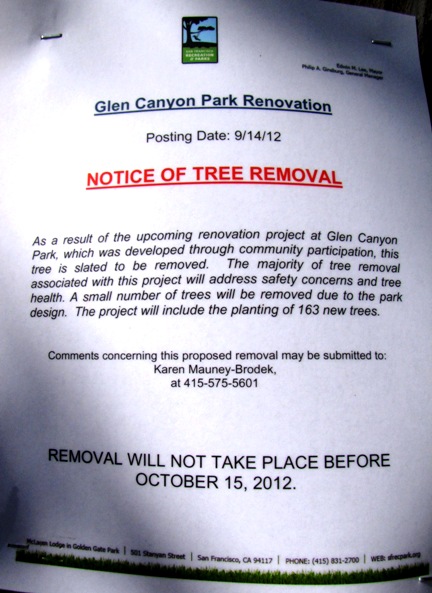
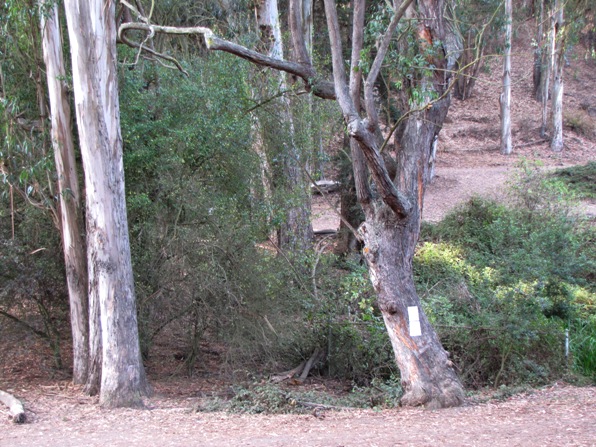
It’s started. SF Rec and Park have posted signs indicating some of the trees that are to be chopped down. The comment period is open until October 15.  Here are some of the trees that will be felled.

If you wish to protest, this would be the time. (HERE is a link to what you can do, scroll down to the bottom of the page.)

This series of tree-cuttings is part of the Tennis Court/ Playground project, which we protested. This is the one where all the community discussions mentioned 10 or 11 tree removals, and it was not until June 2012, after all the workshops were over that SF RPD revealed they intended to cut down 70 trees over a much wider area than had been discussed at the workshops. Of these trees, only 1 is hazardous. The remainder have “poor suitability.”

That’s one. Here’s another.

And another.

And another. (Actually, two – the slanting tree on the right, which kids would love to clamber on – that’s going too.) Sadly, there will be more.  [Edited to Add: There already are. CLICK HERE to see more trees you can help to save.]

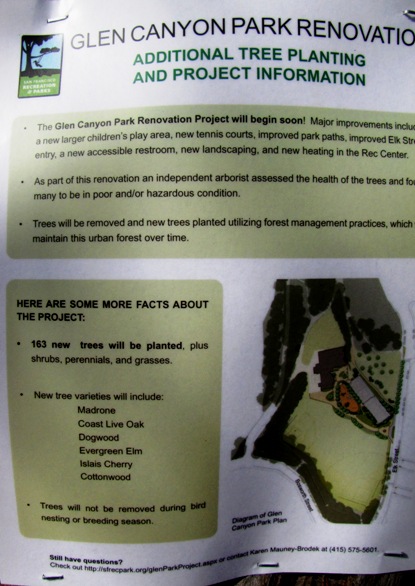
SF RPD say they’ll plant 163 trees. They’ve mentioned a few varieties, but there’s no clear indication of how many of what will go where.

Posted in Felling Trees | Tagged , , , | 1 Comment

Destroying Wildlife Habitats

Glen Canyon is home to a lot of birds, animals and other wildlife. There’s the famous Great Horned Owl’s regular nesting tree. Bewick’s wrens nest in Glen Canyon, too, and birders have seen over 50 species there. Then there are animals: coyotes, skunks, raccoons, squirrels, and rodents that are prey for the coyotes and hawks and owls. There are two natural bee hives in tree hollows.

TREES ARE HABITAT

This plan would destroy important habitat for the wildlife that lives here.

Much of the wildlife in the canyon uses or benefits from the tall, majestic trees. The eucalyptus hosts many species and sizes of birds, from the Great Horned Owls to the tiny Brown Creeper. The Monterey pine is habitat for kinds of birds and insects and other wildlife that need conifers.

Even the dead and dying trees that would be cut down have important habitat value: they are critical for cavity nesting birds and animals; they attract insects that are food for woodpeckers and other birds; they host interesting fungi that cannot grow elsewhere. They increase the biodiversity of the environment.

The nativists argue that native plants are better habitat for insects and thus for the whole ecosystem. It’s not true. Recent research from Professor Douglas Tallamy indicates that insects eat non-native plants as enthusiastically as native ones. (Click HERE for an article about that research.)

[Click HERE for a beautiful series of pictures of the Birds of Glen Canyon Park.]

NATURAL BEE HIVE TREE TO GET THE AX

Quite sadly, one pine tree targets for cutting is home to one of the bee hives in Glen Canyon. (This would be in addition to one inadvertently destroyed last year.)  [Edited to Add: Work by the bee-keeping community of San Francisco has apparently resolved this through discussions with the SF RPD. The tree, which is assesses as hazardous, will be amputated at the 60-70 foot level, thus reducing the risk while hopefully preserving the hive.]

Even the lovely, gnarly acacia that provide a screen beneath the towering Eucalyptus along the Rec Center will be gone. Acacia is also an extremely valuable habitat tree; its seeds are a food source for insects and birds, and the thick understory is a place for birds to hide from predators and build nests.

SF native plant gardens certainly have value but Rec & Park has not proven that they can create and sustain native plant gardens outside of wetland areas.  It is time to stop ripping out healthy and self-sustaining landscaping and instead start spending time caring for and maintaining what we are fortunate to have with majestic, healthy trees in our urban open space areas.


Posted in Impacting Wildlife | 4 Comments

Glen Canyon Trees: Who Knew?

We believe that if neighbors had realized how many trees are targeted for destruction in Glen Canyon, most them would object. Even of those who support the Capital projects, perhaps even some of those who support the Native Area Program. But we haven’t found anyone who actually knew how many trees they stood to lose – even those who are regular visitors to the Park. To recap, our estimate is upwards of 400 trees will be felled:

  • Rec Center Capital Project – 2008 Bond (Fall 2012): 68 trees
  • Forestry Capital Project – 2008 Bond (Fall 2012): 160 trees
  • Trail Restoration Capital Project – 2008 Bond (Fall 2012): 32 trees
  • SNRAMP Large, Healthy Tree Removal Proposal (2013): 120 trees
  • SNRAMP Young Tree Thinning Proposal (already occurring): unknown number
  • Willows (native) for daylighting creek (already occurring): unknown number
  • Documented Past NAP Creek Projects (2008): 24 trees

In addition, there are reports of trees cut before 2012 (including evidence such as stumps) of around a 100 trees.

THE REC CENTER PROJECT’S COST IN TREES

An example is the tree removal for the Rec Center Project, slated to begin this Fall. Some 68-70 trees are to be felled in this part of the project alone (not counting the Trails project or the Natural Areas Program).  This was never defined or discussed in the Glen Canyon Recreation community meetings or other public meetings held in 2011 but instead announced only in June 2012 by Dennis Kern announced, at a meeting of the Diamond Heights association.

In fact, the “final” presentation on the Rec Center capital project (December 2011) clearly does not show such extensive tree removal (see the picture below).


Source: Final Glen Canyon Community Meeting Presentation — Dec. 10, 2011

Click to access GlenCanyonCommunityMeetingPresentation-Dec.10.2011.pdf

TENNIS COURT TREE REMOVAL MAPS

Also, the Tennis Court Relocation Diagram that was produced to specifically to address community concerns regarding trees doesn’t indicate any plans to remove trees because of “poor suitability” or to remove trees from the hillside slope or meadow. The only trees identified for removal are the cluster behind the tennis court – outlined in white on the picture below. If you compare it with the map at the bottom of this article, you will see that it’s not just those trees – sad as that loss will be – it’s all the trees behind them as well.

(Source: http://sfrecpark.org/documents/GlenCanyon_TennisCourtRelocation.pdf)

To complicate matters even more, we had to use a Sunshine Act public records request to get the Rec & Park hired arborist’s recommendations for tree removal. It’s a long, cryptic report with dense maps that recommends removing between 200-400 trees.

“Poor Suitability” was the arborist’s only justification for removing 176 of these trees. “Invasive” (aka non-native tree) is likely a significant factor in the criteria that the arborist used to determine the “poor suitability” designation. But Rec & Park continues to present the tree removals as “hazardous” in meetings when in fact it’s the “non-native species” criteria driving tree removals for this project.

A CONTRACT OUT ON THESE TREES

We developed the map below from the bid contract documents and the arborists report. It shows how many trees are being felled under this one contract – and  the reasons why, which have very little to do with safety.

In addition, the area for tree cutting included in the contractor bid (pink + green in the map below) is much larger than discussed in the community meetings (green area).

NOT HAZARDOUS

In his speech – and again at the August 16th meeting of the San Francisco Parks Commission – Dennis Kern stated that 60 trees are being removed as “hazardous.’ In reality, almost none of the trees slated for removal in Glen Canyon has been evaluated as hazardous.

[Click HERE for an analysis of Hazardous trees in Glen Canyon from the arborist.]

In fact, money is being wasted on destroying trees that pose no threat and most people enjoy their sheer size and beauty.

Posted in Felling Trees | 2 Comments

Analyzing the Arborist’s Report

Using the Sunshine Act, we obtained the report from Hort Science, San Francisco Recreation and Parks’ hired arborist.
The arborist evaluated 250 trees near the Recreation Center, and another 377 trees elsewhere in the Park. They recommended felling 247 of the trees – nearly 40% of the ones they checked. Why?

Here’s the breakout:

For those who would like to go into detail, here’s how the Hazard Rating system works.

THE HAZARD RATING SYSTEM

The method Hort uses for rating trees is this. It considers three factors:

  • Failure potential (How likely is it that the tree would fall or drop a limb);
  • Size of the part that would fail (the size of the tree or the branch);
  • Value of the target area (if it fell, what would it damage?).

Each is scored on a scale of 1-4, and the scores are added together. This gives a tree a  rating of 3 (least problematic) to 12 (most problematic).  Only a small young tree far from any road or building or playground would be a 3. The RPD action threshold is 9, and most trees with a 9 rating (and some with an 8 rating) would be removed.

This methodology is strongly biased against large trees in busy areas. For instance, a big tree near a roadway would get a score of 4 for size, and 4 for “value of target.”  This means it is an automatic 9, because the score for “failure potential” cannot be less than 1.

We have a problem with this, but that is an issue for another day. For now, we would like to point out that only 39 trees of the 627 evaluated in Glen Canyon were rated 9 or higher.

The immediate threat is to the 70 trees that have been contracted already – only one of which was rated “hazardous.” We based the map below on the one from the bid documents for the project contract. We looked at each tree that is contracted to be cut down, and checked it against the Hort Science report. Here’s what we found: One hazardous tree. Fourteen trees dead or dying (and there are reasons to save those for wildlife). Ten trees that are being felled to move the tennis courts and make way for the grand entrance. And 42 trees that have “poor suitability.”

Posted in General | 3 Comments