Glen Canyon Park: Another Appeal Submitted

Edited to Add: The appeal described below was ruled “untimely.” This left the possibility of legal action by the environmental group WiserParks (formerly known as ForestForestForever), which they decided not to pursue for practical reasons.

Environmental group ForestForestForever has submitted an appeal to the Board of Supervisors requesting that the City re-examine their environmental compliance for the Glen Canyon Park Renovation Project. The project had been scheduled to start in October 2012 with the felling of nearly 60 trees, a prelude to the destruction of hundreds of others.
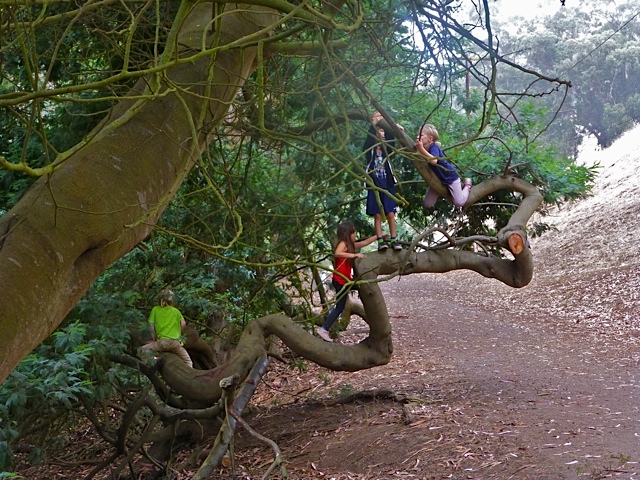
This tree is to be felled

This tree is to be felled

As SFForest noted in its post, Under the Radar, when the San Francisco Recreation and Parks Department filed for an exemption under the California Environmental Quality Act (CEQA), it said that none of the proposed work would be in the “Natural Areas” of the Park. This enabled it to get a permit to go ahead with the project without doing an Environmental Impact Review (EIR).

CLICK HERE to read that article: Natural Areas Program Under the Radar in Glen Canyon

As the map clearly shows, a substantial portion of the contract area is in fact in the Natural Areas. What is proposed for that area  – the removal of trees and replanting with native plants – is exactly what the Natural Areas Program wants done. (SFRPD claims it will plant 163 trees. Two problems: Half of them are actually bushes and shrubs, not trees; and actually only 113 “trees” are in the contract.)  CLICK HERE to read what they say they’ll do: A New Planting Plan for Glen Canyon.
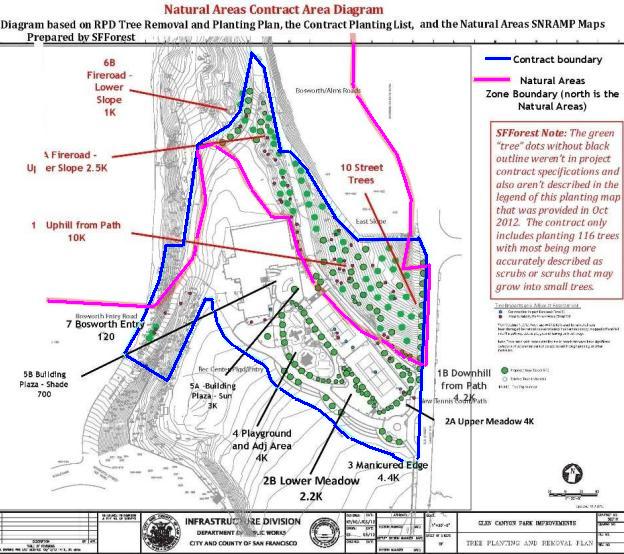
sm Diagram of Natural Areas Contract Area oct 29 2012

IT’S NOT JUST A MINOR ERROR

Besides the issue of SFRPD making erroneous statements,  there’s a more important matter at stake. An Environmental Impact Review would need to review all the actions planned for the area, cumulatively. This would mean that SFRPD couldn’t split up the projects, minimizing the impact of each one, as it has been doing. Even if the individual impacts are not huge, cumulatively they will change the Canyon drastically.

In an EIR, SFRPD would have to consider the total effect of cutting down hundreds of trees in a relatively small area, the impact of pesticide use especially because it is near a water body. It would need to consider the overall impact of the Rec Center Project, the Trails Project, the Forestry Project, the Natural Areas Program, and any new work planned now under the 2012 Bond. It would probably also need to consider plans for Twin Peaks and Mount Davidson, which are part of the watershed of Glen Canyon Park and Islais Creek

From ForestForestForever’s press release (slightly edited): “According to environmental regulations, changes in the same area must be reviewed cumulatively. All the Canyon plans and assessments call for cutting down hundreds of trees in the Canyon – plus Rec & Park has plans to cut down thousands more trees in nearby city parks such as Mt Davidson. Along with allowing one to escape from city living, trees are home to forest wildlife and absorb air pollutants, sequester carbon, and release oxygen and are the “lungs” of the city.”

BOARD OF APPEALS “HAMSTRUNG” – ONWARD TO THE SUPERVISORS

The spokesman noted that they “made the decision to take this action after the matter had gone before the San Francisco Board of Appeals, and was rejected. At the November 14th 2012 Board of Appeals hearing, the Board President, Chris Hwang, expressed serious concerns about this ‘flawed public process,’ and added that she felt that because the Board of Supervisors had exclusive jurisdiction over environmental review issues, it had ‘hamstrung’ the Board of Appeal’s ability to choose a different course.

ForestForestForever  also noted that it was surprising that the City tried to bypass “bedrock environmental regulations and the local guidelines that are required of ordinary citizens and businesses.”
Posted in Felling Trees, Natural Areas Program | Tagged , , , , | 2 Comments

Glen Canyon’s Updated Planting Plan – Nov 1, 2012

Yesterday, we obtained a new Master Planting Plan for Glen Canyon Park.  Nearly half are still shrubs and small trees. Still, it’s an improvement over the previous one, dated May 2012. It actually has some tall trees in it

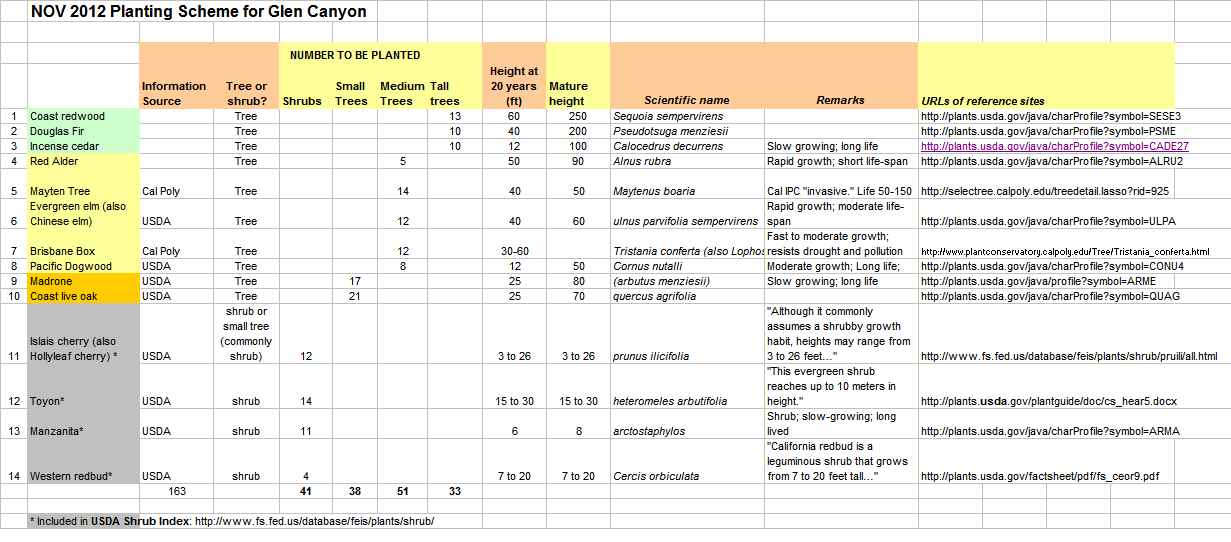
[Edited to Add, March 2013: In response to someone who apparently said we “told lies” and specifically mentioned our allegation that a number of the so-called trees to be planted were actually shrubs, we offer our worksheet that notes the  links to the USDA sites that describe the Hollyleaf cherry, toyon, manzanita, and Western redbud as shrubs.

tree planting plan species details

Click on the chart to go to a larger version of the picture.]

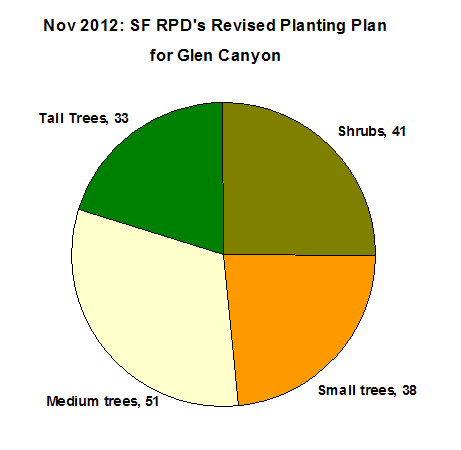
[You can read about the earlier plan here: Reforesting Glen Canyon with Bushes. The pie-chart below is from that plan. ]

WHY IT’S SOMEWHAT BETTER

The tree-and-shrub numbers actually add up to 163, the number SFRPD has been posting all over the place as the number of trees they’re planting. (The previous plan only showed 116, of which only 6 were tall trees.) Here’s the new breakout:

  • Tall trees: 33. The six cottonwoods – the only tall trees on the previous list – are gone, replaced by 33 Coast Redwoods, Douglas Fir, and Incense Cedars. These will grow 80-140 feet high.
  • Medium trees: 51. Pacific Dogwood (a medium-sized tree) substitutes Redtwig Dogwood (a bush) in the new plan. It’s rather susceptible to pests, which have wiped it out in many places; we’ll wish these ones a happier fate. Five Red Alders are also new. These trees are about 40-60 feet tall.
  • Small trees: 38. That includes Coast Live Oak, included because it’s very slow-growing so will be a shrub in most of our life-times; and madrone. They’re about 20-30 feet or so.
  • Shrubs: 41 of 163. The flannel bush and gooseberry and redtwig dogwood are gone; instead there’s redbud and toyon and manzanita (not the endangered kind). These are 10-25 feet tall.

The map above shows where the trees are going –

  • the dark green are the tall trees,
  • the pale yellow the medium-sized ones,
  • the orange are small trees, and
  • the brown are the shrubs.

For a more detailed PDF of the plan (which breaks it out by species) go here: FINAL TREE PLAN REV1 Nov 2012

ALLERGENS

Getting rid of buckeye from the list is good, they’re toxic to bees and the Canyon has two natural hives. [Edited to Add: One was wiped out during the tree-felling.] But we think people with pollen allergies should be aware that Coast Live Oak is a severe allergen, and Red Alder a moderate one. Incense cedars may cause an allergic reaction in people sensitive to cedar pollen (cedars generally are allergenic).

Posted in General | Tagged , , , | 6 Comments

If You Can’t See the Videos…

This is copied over from SFForest.net

Some of our readers see our posts in their email boxes, if they’ve subscribed to this site. If you’re one of them, this is a heads-up that you may not be getting the whole picture (pardon the pun). In particular, many people’s email won’t support video links. Our post about the pretty propaganda from the Natural Areas Program won’t make much sense if you can’t watch the videos. Similarly, some email boxes block pictures, or truncate longer posts.

The solution is simple: Click through to the original post (usually by clicking on the headline of the article in your email box).

Posted in General | Leave a comment

Natural Area Program’s Pretty Propaganda – and Some Truth-Telling

This is republished from SFForest.net

The Natural Areas Program’s response to its critics is a very pretty piece of propaganda: This Youtube Video. Please do watch it, it’s under five minutes of lovely images and soothing voice-over.

Only… it’s remarkably misleading.

The “biodiversity hotspot”? That applies to all of California, not just San Francisco. The pretty yellow flowers in the meadow? Those are non-native plants that NAP hunts down with pesticides like Garlon and Roundup. (The poppy shown close-up in the next frame is not from the same meadow.) The happy dogs on Mount Davidson? They’re off-leash, something the Native Areas program has been fighting tooth and nail.

(Don’t try to comment on the NAP’s Youtube video, they’ve blocked comments.)

Watch the real story here, there’s lots more. How much misdirection in 5 minutes? See our 2-minute rebuttal video for yourself.

Posted in Natural Areas Program | Tagged | 1 Comment

“Reforesting” Glen Canyon with Bushes: What 163 trees?

San Francisco Recreation and Parks Department (SF RPD) has been claiming that it will plant 163 trees to replace the 58 trees it currently plans to fell for the Rec Center (2008 Bond) project that will move the existing tennis courts uphill and make way for a grand entrance to the park.

We have noted that most of those 163 “trees” are bushes and small trees.

WERE WE EXAGGERATING?

They’ve been spreading the myth that we are making it up. Here’s what an article published in the Glen Park news blog says:

[SF Forest Alliance] statements have also said that much of what would be planted would not in fact be trees, but bushes. However Mauney-Brodek said that the species could include madrone, coast live oak, dogwood, evergreen elm, Islais cheery and cottonwood trees. “They range in size up to 100 feet at maturity.”

Except it’s not true. We obtained the Master Planting Plan dated May 2012, which according the SF RPD is the latest they have on that matter.

[Click here for a PDF of the Plan:  a 05-12 Round 1 – May 2012 – Master Planting List for Project ]

It only lists 116 “trees” to be planted. Of those, how many will be 100 feet at maturity?  Only 6.

Here’s what their Master Plan says they will plant:

  • 40 Bushes. Of those, 40 are actually bushes – flannel bush and gooseberry (35 of them), which grow about 6 feet tall, and five redtwig dogwoods, which are 5-20 feet tall.
  • 38 Small Trees. Another 38 are small trees (Hollyleaf Cherry, Madrone, Buckeye, and Coast Live oak), which would be about 25 feet tall at maturity. (We’re including the seven Coast Live Oak here, because they’re so slow-growing they take 20 years to reach that height. If they survive the epidemic of Sudden Oak Death that has already arrived in San Francisco, they could grow up to 80 feet.)
  • 31 Medium size trees. Some 31 trees  (Elm, Mayten, Tristania) that will actually be 40-60  feet in height at maturity. (Of these, 11 will be street trees,  presumably planted along Elk.)
  • 6 Tall trees. Then there are the cottonwoods, which can indeed exceed 100 feet in height. There are six of them.

LOTS AND LOTS OF NATIVE PLANTS

Most of the Master Planting Plan, for those who don’t actually want to dig through the thing, is mostly about small plants and seeds – almost all Native Plants. They’re planning on lupine and California bluebells, coyote brush and coffeeberry,  Douglas iris, sticky monkey flower, manzanita and rosemary. Ceanothus and western sword fern. Purple needle grass, which is incidentally not so good for dogs – it can stick in their ears.

How much is this going to cost? We’re not sure, (the plants alone would be around $175,000 at retail) but we wonder if establishing a Native Garden is a higher priority than some of the other things they have not funded in this project.

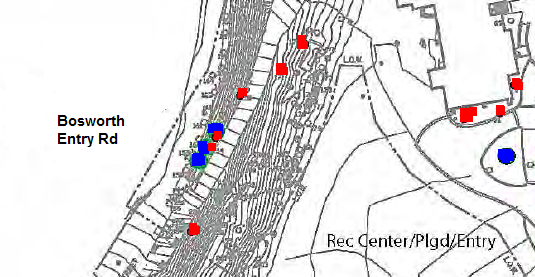
What they have shared, besides the Master Planting Plan, is a map which shows “trees” to be planted as big green dots, and trees to be removed as small green dots and small red dots.

[Click on the link for a PDF:  October 2012 – RPD Diagram of Plan of Tree Removals and Planting ]

It’s confusing, not to say ironic, given that the trees being felled are mature and large, while most of those planted will be saplings and bushes.  So here are a couple of improved versions: We’ve put red dots for all the trees being removed, and put blue ones for the “trees” being planted. (Except, of course, we know that many of those are not actually “trees.”) [Edited to add: It was so confusing that even we got confused. Here is a corrected version of the map.]

It’s also confusing for another reason: It doesn’t match the Master Planting Plan. The forest of blue dots on the East Slope ? Mostly bushes, with 13 madrone, coastal live oak, and buckeye. It’s going Native, which is of course in keeping with the Natural Areas Program – it’s within the Natural Areas boundary.

This picture below is from the other side, near Bosworth. Here again, the red dots are trees being felled, and the blue dots are “trees” being planted.

WHAT ARE THEY HIDING?

Does SF RPD have a new planting plan with 163 actual trees in it? If so, they have not shared it with the public.

[Edited to Add: SF RPD published a new planting plan on Nov 1, 2012. Our analysis is HERE.]

Transparency and communication is essential to restoring trust. This is not achieved by communicating more misleading statements through allies like Glen Park Association (which often quotes SF RPD staff on its blog), but through providing transparent information and engaging with its critics.

Posted in Felling Trees | Tagged , , , , | 8 Comments

The “Hazardous” Trees of Glen Canyon

[Note: This article has been edited for clarity and to add the video clip of Dennis Kern of SFRPD misstating the number and hazard of the trees.]

The latest information for the number of trees to be removed very soon for the Rec Center Project (the Entrance, tennis courts, playground, restroom, and heating system) is 58 trees. We are told – repeatedly – that these trees are being removed because they’re hazardous.

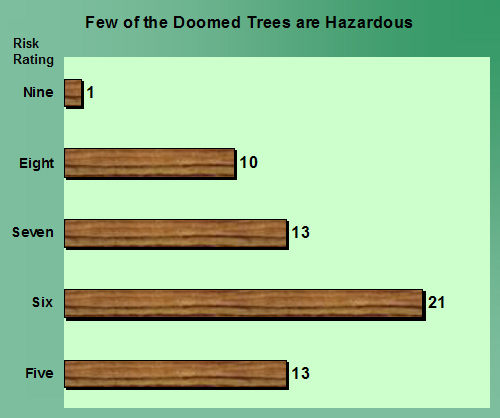
Only they’re not. Using the  standard rating system from SFRPD’s own hired arborist Hort, only one tree to be removed is hazardous.

Read on for more.

Dennis Kern tells the Park Commission about 60 hazardous trees.

Here’s a link to a video of Dennis Kern at the Parks Commission meeting, saying they had very specific numbers: 60 trees were hazardous, and another 10 were in the way of the project. The SF Weekly newspaper reports: ” However, 52 of the 58 trees set for imminent chopping were identified in 2004 as safety hazards; renovation funds finally gave the department the chance to weed them out, [SF RPD’s  Sarah] Ballard says.”

 HOW MANY TREES?

The signs say 58, but the arborist’s latest report (October 2012) lists only 57 trees by tag number. This is  a minor level of confusion compared to what went before. The estimates went from 10-11 trees mentioned during the community meetings (which already upset many neighbors), to 70 trees end-July when Kern claimed they had “a very specific number”, and now is back down to 57 or 58.

But the more important point: Are they really hazardous?

A few days ago, we received the arborist’s new report [dated October 1, 2012]. It covered the same 627 trees, but now the 147 trees with the project area have actually been given a risk rating. (Before, they only got an eyeball estimate of condition.)  So we had a look at the risk rating for the trees recommended for removal.

If the trees for removal were hazardous, they’d have a high risk rating. Did they? Not so much.

RISK-RATING OF 9 OR MORE = HAZARDOUS

The methodology being used for risk rating yields a scale of 3-12. (The details are below.)  The average tree would fall somewhere in the 5-8 range. San Francisco city uses a rating of 9 as a threshold for action – a tree rated 9-12 needs removal or remediation.

So, of the 58 trees for removal, how many were rated 9 or higher?

Only one.

There weren’t even very many 8s. Most of the trees tagged for removal were rated 5-7 — better than most trees across the city.

THE HAZARD RATING SYSTEM

The method Hort uses for rating trees is this. It considers three factors:

  • Failure potential (How likely is it that the tree would fall or drop a limb);
  • Size of the part that would fail (the size of the tree or the branch);
  • Value of the target area (if it fell, what would it damage?).

Each is scored on a scale of 1-4, and the scores are added together. This gives a tree a rating of 3 (least problematic) to 12 (most problematic). Only a small young tree far from any road or building or playground would be a 3. The City’s action threshold is 9, and most trees with a 9 or higher rating would be removed.

This methodology is strongly biased against large trees in busy areas. For instance, a big tree near a roadway would get a score of 4 for size, and 4 for “value of target.” This means it is an automatic 9, because the score for “failure potential” cannot be less than 1.

IS GLEN CANYON FULL OF FAILING TREES?

So is Glen Canyon full of failing and dangerous trees? Not according to Hort Science updated evaluation.

They looked at 480 trees elsewhere in the Canyon. Of the 59 trees they recommended for removal among those trees, only 13 had a risk rating of 9 or higher. Another 26 trees had a risk rating of 8 and were in poor condition. Twenty more trees were recommended for removal because they were growing on a steep slope.

And that wonderful tree full of kids  in the picture?  It’s Tree #22, a Bailey’s acacia. It’s tagged for removal with a risk-rating of 7.

Posted in Felling Trees | Tagged , , , | 4 Comments

Glen Canyon Trees: Decoding the Arborist’s Reports

In September 2012, we published our analysis of the tree-felling expected in Glen Canyon. A new arborists’ report dated October 1, 2012 changes the numbers.  It now recommends cutting down nearly 150 trees – still a lot, but an improvement on the 279 earlier recommended.

Back in September, in the first project (playground, tennis court, grand entrance, restroom and Rec Center heating) they expected to cut down 68-70 trees (after initially talking of 10 or 11 trees). According to a statement by Dennis Kern, 10 were in the way of the project, and 60 were hazardous. According to the Arborists’ Report (dated March 2012) only one of the trees was actually hazardous, and another 14 were dead or dying. The others were being removed because of “poor suitability.

TREE FELLING PROJECTIONS

When they actually announced the start of work, they revealed that the plan was to fell 58 trees. This is different from the 68-70 proposed earlier, and we wondered why. Tree felling could have started any day after October 15th, last Monday. However, a tree-loving neighbor appealed the project, and it will be delayed for some weeks until that appeal is resolved.

So what’s tagged for felling now (for this project)?

  • 6 trees that will be impacted by the project (Tag numbers 62, 63, 64, 65, 68, and 70). Five of the trees, earlier marked “maybe remove?” are now certainly on the chopping block. This includes the gracious old eucalyptus at the entrance from Elk St.
  • 1 tree (eucalyptus tagged #9) with a risk-rating  of 9  (on a 4-12 scale where 3 is best and 12 is the worst).
  • 7 trees with a risk-rating  of  8 (tag numbers 3, 11, 28, 41, 55, 59, and 170).
  • 43 trees with “poor suitability.”

That’s 57 trees. (Why it’s not 58, we don’t know exactly.)

WHAT CHANGED?

Meanwhile, we obtained a new edition of the Arborist’s report, this one dated October 1, 2012. This report is a reworking of the March report, still covering 627 total trees evaluated. However, it now includes an actual hazard rating for each tree.

  • Fell 117 trees, not 247.  It recommends felling 58 in the project area; and another 59 trees elsewhere in the park, for a total of 117 trees. This is a lot better than the original recommendation, which was to remove 190 trees in the project area and another 57 elsewhere in the park – 247 trees. (SF RPD did not actually decide to remove 190 trees in the project area; the 70 trees were some subset of that.)
  • Fewer trees in the Project Zone. The most important change in the report’s new edition is that they reduced the number of trees defined as being inside the project area: it’s now 147 of the 627 trees instead of  250 of the 627 trees as in the March report. Three of the original trees are already gone, so that’s a difference of 100 trees.
  • They’re not all the same trees as before. Some trees originally recommended for preserving are now to be removed, and vice versa. We haven’t understood the reasons in most cases. We’re still asking SFRPD for a walk-through and explanation.
  • Among those to be “preserved” is the bee-hive tree, a Monterey pine (tag #38).  Though it was earlier said to be hazardous, it only has a risk rating of 7.

HOW THE RISK RATING WORKS

The arborists evaluate each tree on three criteria:

  • Failure potential (how likely is the tree to fall or drop a branch);
  • Size of the falling part;
  • Importance of the target (if it fell, what would it damage?)

For each criterion, they score the tree on a scale of 1 to 4 (best to worst). Then they add up the scores, which gives a Risk scale of 3-12, where 3 is the best and 12 the worst.

A small young tree in a forest would probably score a 3. A big diseased tree near a school might score a 12. Most trees score between 5 and 8. A score of 9 is the City’s threshold for action; it will remove or prune the tree. A score of 8 is more of a gray area.

WHAT DOES THIS REVISION MEAN?

We don’t know what this means for the excluded trees: are they saved? Or will they fell them in a separate project, one of the many that are scheduled to remake the Canyon? Other tree removals likely:

  • The Significant Natural Areas Management Plan calls for cutting down another 120 trees; that is expected to go into effect in 2013 or 2014 if the Environmental Impact Review is okayed.
  • Any tree under 15 feet tall can be removed without notice for any reason.
  • As of now, our best estimate for the number of trees to be felled exceeds 300 trees.

As the number of trees affected by Glen Canyon Park’s makeover fluctuates, we will try to follow and report on the projected numbers.

PLANTING 163 “TREES”?

The SF RPD has written about planting 163 trees in Glen Canyon Park. We have a planting plan dated May 2012. It only lists 116 “trees” –  a classification in which it includes bushes (for example, flannel-bush and red-flowering currant) and vegetation USDA describes as “shrubs or small trees.”  Less than a third of the saplings will grow to be over 40 feet tall in the next 25 years.  (We’ll get back to that in another post.) [Edited to Add: We did, HERE.]

Posted in Felling Trees | Tagged , , , | Leave a comment

Support for the Trees: Glen Park Association Meeting Oct 2012

We’d like to thank Michael Rice and Sally Ross of the Glen Park Association for holding an open and well-run meeting last night, 18 Oct 2012.

A number of topics were discussed, but the most important from our point of view was the Glen Canyon Rec Center project (the current phase involving tennis courts, a playground, and a rest-room – and the felling of 58 trees). District 8 Supervisor Scott Wiener was present, as were about 30-35 people.

Supervisor Scott Wiener spoke about various things, and then about what concerned us:

1) He said there had been an appeal on the renovation which targeted the building permit which has nothing to do with the peripheral trees, so now the project would be delayed

2) He wanted to make sure everyone received his posting about the “misinformation” sent out by SF Forest, that SFForest had given the impression 300 trees would be felled when it was just 58. He also said that it shouldn’t be considered part of the Natural Areas Program, where the Draft Environmental Impact Report has yet to be certified. He then opened for questions.

THEMES THAT EMERGED

During a vigorous Q&A session, it became clear that the community had serious questions both about the project and the process. Some of the themes that emerged:

  • Support for the Appeal.  Though the appeal was filed by one person, she had a lot of support, and SF RPD should revisit the project.
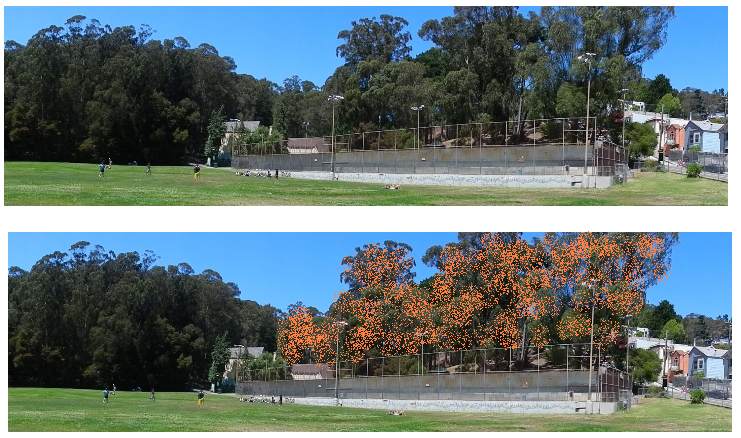
  • Protect the Trees.  Glen Canyon Park’s famous “owl tree” (in which a Great Horned Owl has regularly nested) has 11 “sister” trees that had been planted during Grover Cleveland’s presidency and were over 100 years old. A number of these would be cut down in the SF Rec & Park’s Plan. (They’re the ones stippled in orange in the picture above.)  By tweaking the footprint of the plan a little bit, those majestic and historic trees could be saved.
  • Flawed Community Process.  The entire community process was flawed: the design and new footprint were not agreed upon by the public. Rather, the public was presented with this plan and not allowed to comment, however much they tried.  The organizers presented 4 plans in the beginning and THEY chose one of those plans at the end. There was no vote. RPD just kept telling us that “they had received many emails”. Input was limited to kindergarten red and yellow stickers to put on maps. The group was divided up between tables and no discussion and conversation allowed.

The tennis community, for instance,  did not want the  tennis courts moved to where the trees are (which will require killing a number of majestic eucalyptus). They wanted the orientation changed from East-West to North-South. The courts should not be near the street.

  • No “Misinformation”, it really is 300++ trees.  A supporter of SFForest  firmly denied that there was any misinformation being disseminated by SFForest, which works hard to provide information as complete and accurate as possible and bases its detailed analysis on actual documents and data. SFForest had to obtain documents under the Sunshine Act when SFRPD had not made them public.

She explained that the tree count for this project had wavered from 11 to 70 and is now 58. In addition to this there were 30 or so trees that would be removed for the Trails project, also funded by the 2008 Bond, an unknown number around 100-200 for the forestry project, and 120 for Natural Areas Program. That the 300-400 trees was what was coming down.

ANOTHER MEETING?

An audience member pointed out, as Scott could see, that many people don’t want the trees removed. He asked Michael Rice (President of the Glen Park Neighborhood Association) and Supervisor Scott Wiener for a meeting – before Dec 5th, the scheduled date for the appeal hearing – to tweak the plans so that the trees could be saved. Scott said he was willing, only if RPD could be there. There was spontaneous applause. Everyone said yes, they wanted to talk with SF RPD.

While SFForest did not file the appeal that will delay the Glen Canyon project, we appreciate the extra time for real community involvement. Once the trees are felled, they are gone forever.

Posted in Felling Trees | Tagged , , , | Leave a comment

The Birds of Glen Canyon Park

Janet Kessler, wildlife photographer, has taken a series of pictures of the birds of Glen Canyon Park. They range in size from the tiny hummingbirds and bushtits to the handsome owls and  hawks.

Click HERE to go to a page of over sixty beautiful bird pictures from Glen Canyon Park. (Here are two three of them.)

Posted in Impacting Wildlife | Tagged , , , , | Leave a comment

Nearly 3,000 Signatures! Delivering the Petitions

On October 14th, we electronically delivered the petitions signed by all of you to our San Francisco Officials and managers. On October 15th, we delivered them in hard-copy versions. We had over 2800 signatures on two nearly-identical petitions. The bound set of signatures looked like a small phone book. We included a cover letter.

The letter was addressed to:

  • Mayor Edwin Lee,
  • District 8 Supervisor Scott Wiener,
  • The Recreation and Parks Commission,
  • SF RPD’s Philip Ginsburg,  and
  • Dawn Kamalanathan and Karen Mauney-Brodek of SFRPD’s capital planning division.

Here’s the cover letter.

————————————-

Dear Mayor Lee, Supervisor Wiener, General Manager Ginsburg, Park Commissioners, and Ms Kamalanathan and Ms Mauney-Brodek:

There is significant community concern and confusion about tree removals in Glen Canyon for reasons other than safety. Almost 3,000 people have signed a petition to stop tree removal unless the tree poses legitimate danger.

We are disappointed that after more than a year of community meetings during which we were repeatedly told only a handful of trees would need to be removed for the Glen Park improvement project, there are now 58-70 trees slated for removal.  Few of these are hazardous or high risk. In fact, according to their arborist, only one tree to be removed is “high risk”.  Rec & Park has refused to conduct a walkthrough or meet publicly with neighbors, even with those who participated in the design of the project. Rec & Park refused to provide the arborist’s reports — we had to obtain them through a Sunshine request. The assessments reveal the number of trees slated for removal in Glen Canyon is significantly higher than disclosed.

Overall, hundreds of trees are slated for removal  using a hodgepodge of criteria that extends well beyond trees classified as hazardous or high risk. Reasons for removals shift according to what program is cited to justify the action. Clearly a disturbing pattern emerges wherein urban park forests like the historic Glen Canyon forest are laid bare, bit by bit, tree by tree, neighborhood by neighborhood.

There is broad community support for the improvements to the Rec Center, playground, tennis courts and ball field. But community support ends there. Make no mistake, neighbors surrounding Glen Canyon and those who depend on this park for recreation and respite (as shown in the thousands of signatures on the attached petitions) do not support cutting down healthy trees – for just any reason. Nor do they feel as though the neighborhood associations represent their will.

On behalf of nearly 3,000 concerned citizens we respectfully submit the enclosed petition opposing the removal of trees in Glen Canyon for reasons other than legitimate safety threats to the enjoyment and use of the park for all people. We request a community meeting and walkthrough that explains the rationale for tree removal. This is an opportunity to listen, re-engage and work together. But the window is closing fast.

Sincerely,

San Francisco Forest Alliance

Attached:  URLs for the two petitions to save Glen Canyon trees:

http://signon.org/sign/stop-the-deforestation?source=c.url&r_by=5596586
http://signon.org/sign/stop-the-deforestation-2

—————————-

WHAT YOU CAN DO

We intend to keep the petition online alive.

Meanwhile, please do write or email all the people above. Their email addresses are here:

MayorEdwinLee@sfgov.org,
Scott.Wiener@sfgov.org,
Philip.Ginsburg@sfgov.org,
recpark.commission@sfgov.org,
Dawn.Kamalanathan@sfgov.org,
Karen.Mauney-Brodek@sfgov.org

Posted in Felling Trees | Tagged , , , | 3 Comments